In the ever-evolving world of molecular biology and biochemistry, new terms, ideas, and discoveries continue to reshape how we understand the building blocks of life. One of the emerging concepts gaining attention among scientists and enthusiasts is mssaminoacid33. Though still relatively new in research discussions, this concept has sparked curiosity in the scientific community for its potential to advance our understanding of amino acid behavior, protein synthesis, and peptide engineering.
In this comprehensive guide, we will explore what mssaminoacid33 is, its structure, how it functions, its scientific relevance, and how it could influence future studies in biology, health, and technology.
What Is mssaminoacid33?
The term mssaminoacid33 refers to a conceptual or experimental amino acid sequence that has been used to study how peptides and proteins form and behave. In simplified terms, it represents a model amino acid chain that researchers can use to simulate real biological processes without needing complex or unstable natural proteins.
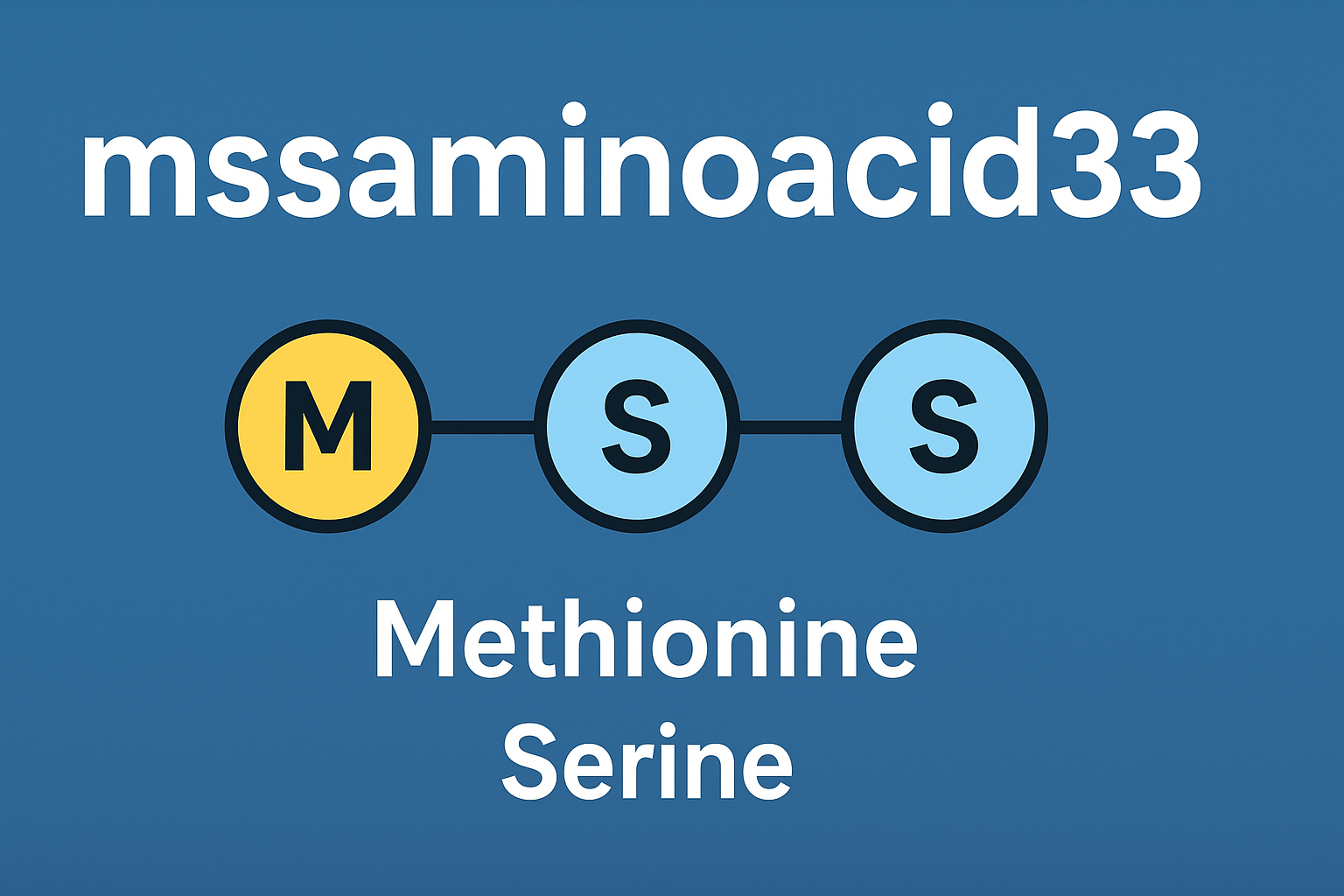
The name itself is believed to derive from the sequence M–S–S, which stands for Methionine–Serine–Serine, and the “33” possibly referring to a specific variant or generation of the sequence used in research. This short chain provides a manageable structure for laboratory and computational experiments, allowing scientists to study folding, bonding, and molecular interactions in a controlled way.
The Structure of mssaminoacid33
At its core, mssaminoacid33 contains three fundamental amino acids:
-
Methionine (M) – A sulfur-containing essential amino acid that often initiates protein synthesis in living organisms. It plays a vital role in cellular metabolism and methylation processes.
-
Serine (S) – A polar amino acid with a hydroxyl group that participates in enzymatic activity, cell signaling, and metabolism. In mssaminoacid33, Serine appears twice, emphasizing its importance in maintaining the molecule’s structural and functional properties.
When these three amino acids combine in sequence, they form a short peptide chain capable of mimicking certain aspects of protein behavior. Researchers can alter this sequence to test how small changes affect folding, bonding, and biochemical reactions.
The Biological Significance of mssaminoacid33
Although mssaminoacid33 is not yet recognized as a natural compound in living systems, it holds remarkable educational and research value. The concept allows scientists to test fundamental hypotheses about how proteins are assembled and how minor modifications in amino acid sequences influence biological outcomes.
For instance, changing even one amino acid in a sequence can drastically alter a protein’s three-dimensional structure. By focusing on a minimal model like mssaminoacid33, researchers can explore these effects more easily, paving the way for deeper insights into molecular design, synthetic biology, and drug development.
Role of Methionine and Serine in mssaminoacid33
Methionine – The Starting Point of Protein Synthesis
Methionine is widely recognized as the “start codon” amino acid in biological protein synthesis. It signals the beginning of translation in ribosomes, the cellular machinery that builds proteins from mRNA templates. In mssaminoacid33, Methionine’s presence at the start of the chain symbolizes the initiation of peptide formation and provides a base for subsequent amino acids to attach.
Methionine also contributes to critical cellular processes such as detoxification, antioxidant defense, and methylation cycles, which regulate DNA expression and energy production.
Serine – The Versatile Functional Amino Acid
Serine, the other key component of mssaminoacid33, plays multiple roles in biological systems. It participates in:
-
Catalytic functions in enzymes, especially those involved in metabolism and energy transfer.
-
Signal transduction, acting as a site for phosphorylation, which helps cells communicate and regulate growth.
-
Protein stability, as its hydroxyl group can form hydrogen bonds that support folding and structure.
In the mssaminoacid33 model, the double Serine arrangement allows for versatile interactions, making it ideal for studying enzyme-like behavior or synthetic peptide design.
Educational and Research Applications of mssaminoacid33
One of the primary benefits of mssaminoacid33 is its versatility in education and research. Because it represents a simplified yet functional peptide model, it helps scientists, teachers, and students visualize how amino acids come together to form more complex proteins.
Some major applications include:
-
Biochemical Education – Teachers can use mssaminoacid33 as a practical model to demonstrate how peptide bonds form, how folding occurs, and how the sequence determines structure and function.
-
Computational Modeling – Researchers can simulate the folding and energy behavior of mssaminoacid33 using computer algorithms, providing insights into protein dynamics and molecular stability.
-
Synthetic Biology – Scientists experimenting with new protein designs can use mssaminoacid33 as a foundation to build synthetic peptides for medical, industrial, or environmental use.
-
Pharmaceutical Development – Understanding the behavior of short peptide sequences like mssaminoacid33 helps pharmaceutical researchers design better peptide-based drugs and delivery systems.
How mssaminoacid33 Helps Us Understand Protein Folding
Protein folding remains one of the most complex puzzles in molecular biology. When amino acids link together, they must fold into specific three-dimensional shapes to function correctly. Even small errors in folding can lead to diseases such as Alzheimer’s or cystic fibrosis.
Using mssaminoacid33, researchers can examine how a small, controlled peptide behaves under different conditions—such as variations in temperature, pH, or ionic concentration. These controlled studies can help scientists understand why some proteins fold correctly while others misfold, providing valuable clues for medical science.
Potential Future Uses of mssaminoacid33
The applications of mssaminoacid33 extend beyond basic research. As biotechnology continues to evolve, this conceptual peptide could play a role in several advanced fields:
-
Nanotechnology and Materials Science – Short peptide chains like mssaminoacid33 could be used to build nanostructures or biomaterials with specific properties, such as self-healing surfaces or biocompatible coatings.
-
AI-Driven Protein Design – Artificial intelligence systems are now capable of predicting protein structures based on amino acid sequences. By training these systems on simpler models like mssaminoacid33, researchers can improve prediction accuracy for larger, more complex proteins.
-
Therapeutic Peptide Engineering – Peptides are increasingly used in medicine as alternatives to traditional drugs. Understanding how sequences like mssaminoacid33 behave may help scientists create more stable, effective, and targeted therapeutic peptides.
-
Nutritional Science – Since amino acids form the foundation of dietary proteins, studying mssaminoacid33 may reveal how small peptide fragments influence metabolism, recovery, or muscle repair.
Challenges and Limitations
While mssaminoacid33 presents exciting possibilities, it also faces limitations. The term itself is still emerging, and its definition varies depending on context. Additionally, laboratory applications may not perfectly replicate real biological conditions.
Some challenges include:
-
Limited experimental data confirming its natural occurrence.
-
Need for standardized research frameworks to compare results.
-
Potential over-simplification of protein behavior.
Nonetheless, these limitations are not drawbacks but rather opportunities for further research and innovation.
The Future of Research on mssaminoacid33
As the scientific community continues to explore synthetic biology and molecular engineering, concepts like mssaminoacid33 will become increasingly relevant. Future studies may reveal how such short amino acid sequences can be used to design custom enzymes, improve drug delivery systems, or even replicate primitive proteins that existed during the early stages of life on Earth.
Moreover, integrating computational modeling, machine learning, and experimental validation will allow scientists to predict new properties of mssaminoacid33 and its variants, leading to discoveries that bridge chemistry, biology, and technology.
Read also: The Rising Global Passion for sã³fbol: A Sport of Skill, Strategy, and Spirit
Conclusion
In summary, mssaminoacid33 represents an exciting frontier in molecular science—a conceptual peptide that simplifies complex biochemical processes into an accessible and research-friendly model. By focusing on the essential elements of protein formation and function, it provides a foundation for exploring everything from enzyme design to peptide-based therapeutics.
While still in its early stages of recognition, mssaminoacid33 embodies the curiosity and innovation that drive scientific progress. As research continues, it may not only deepen our understanding of amino acids and protein synthesis but also inspire new breakthroughs in medicine, biotechnology, and materials science.